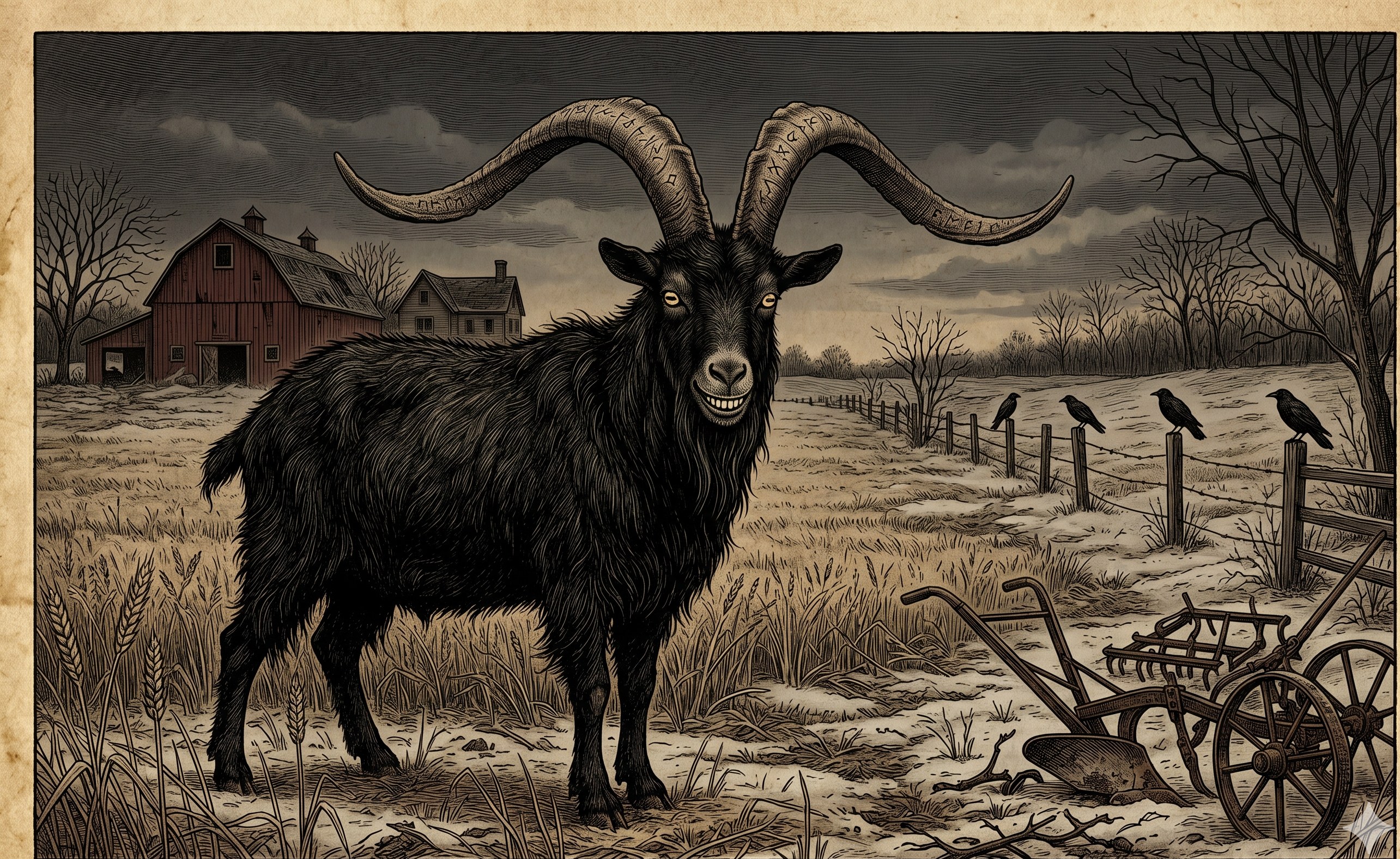
He appears in Midwestern farm fields in the winter before the family sells the land. Locals who have seen him twice in their lives — not unheard of, in the counties where he is known — say he is the oldest ending in American rural folklore: the ending a family has not yet said aloud. He does not cause the sale. He does not announce a death. He simply stands in the field and confirms what the land has already concluded.
The Goat of the Last Pasture is the final entry in the first catalog of this bestiary, and it is, I think, the right creature to end on. He is not the most frightening. He is not the most inventive. He is the most specifically American — a creature of economic grief rather than mortal grief, of foreclosure and auction and the quiet moment a family realizes the farm is no longer theirs to keep. There are counties in southern Wisconsin and northwestern Illinois where every third farmer over the age of seventy has seen him. None of them, by firm local agreement, will be the one to bring him up.
He is, in the phrase of the Finnish-American schoolteacher-folklorist Elsie Korpela — whom readers may remember from the Rattlebone Stag — "the honest animal of the honest last year."
The Origin Legend
The earliest detailed account comes from the diary of a woman named Leida Vanderwerf, a Dutch-Reformed farmwife in Sioux County, Iowa, entry dated 17 January 1881. Vanderwerf and her husband Hendrik had been on their section of prairie for eleven years. The farm had been failing, quietly, for three of those years — drought in 1878, grasshoppers in 1879, a poor wheat price in 1880. The Vanderwerfs had not yet discussed selling. They were the kind of farmers who did not discuss things.
On the morning of 17 January — a cold, clear, windless morning — Leida looked out the kitchen window and saw a large black goat standing in their eastern field. The field had been left fallow that year. The goat was not, obviously, their goat. They had no black goats. Their only goat was a brown nanny named Treffer, visible at that moment in her own pen near the barn.
Leida watched the goat for approximately fifteen minutes. He did not move. He did not graze. He stood in the middle of the frozen field and looked at the house. She noted in the diary — this is the detail that has interested every scholar since — that the goat's horns were "carven with something like writing, though not in any hand I know."
She called her husband. He looked. He said, quietly, "I have been thinking we should sell." She said, quietly, that she had been thinking the same. They sold the farm that spring. The goat was gone from the field by the following morning and did not return.
Leida kept a detailed diary for another thirty-four years, until her death in 1915. She never again mentioned the goat. In the margin of the 17 January 1881 entry, in what was evidently much later handwriting, she had written, in Dutch: hij wacht tot het hardop gezegd is. "He waits until it is said aloud."
"He is not a punishment. A punishment would not be so kind. He is the thing in the field that confirms what the kitchen already knows. There are farms in this county whose families owe him thanks, and they are the ones who will not name him." — Elsie Korpela, interview with an 81-year-old Wisconsin farmer, 1952
What He Looks Like
He is a goat, unambiguously. A large black male goat, roughly the size of an adult ram, with the square build and long beard of a dairy breed rather than a meat breed. His coat is darker than black — witnesses consistently describe it as "absorbing light," "darker than the night shadow beside him," "the color a coat is underneath its color." One Wisconsin farmer in 1963 told Korpela that the goat looked "like a piece of the barn missing from where the barn used to be."
His eyes are a yellow the color of winter straw, with the horizontal rectangular pupils characteristic of all goats. They do not glow. They do not shine. They are simply the wrong yellow for the animal's age — too clear, too bright, too present. Witnesses have reported being unable to meet his gaze for long, not because of horror, but because of the feeling that the goat was evaluating something they had not yet finished evaluating themselves.
The horns are the detail every account returns to. They are long — twenty-four to thirty inches, curving back over the skull in the pattern of a billy goat rather than a ram — and they are carved. The carving is shallow, precise, and consistent across sightings: a continuous band of small angular marks running the length of each horn. Observers have variously called them runes, glyphs, "writing in a language I do not know," and — most commonly, in Korpela's fieldwork — "tally marks, of a kind, but not counting what I could read."
Every serious attempt to photograph the horns has failed. Not because cameras refuse, as with the Lake-Eye, but because the angle is never quite right, the light is never quite enough, the witness's hands shake, the goat turns his head the instant the shutter clicks. There exist approximately eleven photographs of the Goat of the Last Pasture in the folklore record. In none of them are the horns clearly legible. Korpela, who examined three of them in person, noted dryly in 1966 that "he appears to have an opinion about being photographed, and the opinion is that the photographs will not contain his writing."
His mouth is the last detail, and the worst. He has too many teeth. Not fangs — flat molars and incisors, like a goat has, but many more than a goat should, arranged in a way that gives his slightly-parted mouth the appearance of a human smile. Witnesses describe the smile as "knowing." "Patient." "The smile of a man who has been waiting longer than you have." He is not, so far as anyone has determined, actually smiling at the witness. He is simply standing in the field with his mouth in the shape that his mouth is in.
The Reading
Every documented sighting of the Goat of the Last Pasture has been followed, within eighteen months, by the sale, foreclosure, or abandonment of the farm on whose land he was seen. There are no exceptions on record. Korpela, in her 1966 summary, examined sixty-seven sightings across four counties and found zero cases in which the family remained on the land two years beyond the encounter.
This is unambiguous enough that it has, by itself, sustained the creature's folklore for a century and a half. What is more interesting is what the folklore also insists upon: the Goat does not cause the ending. He confirms it. The farms he appears on have, in every documented case, already been failing. The families have, in every case, already been privately considering the sale — even when they had not yet said so to one another, even when they had not yet admitted it to themselves.
Korpela spent much of her fieldwork on this distinction. Her conclusion, published in 1967 in the same county journal that had earlier published the Reverend Pell's Paper Thorax paper, was that the Goat "makes audible to a family the conclusion they had already reached in silence. He does not speak. But his presence is a kind of speaking, and what is spoken through him is the thing the family had not been able to speak for themselves. He is the formal announcement of an informal verdict."
Whether this is a kindness or a cruelty depends, as with the Grinning Auspex, on how the witness receives it. Some families, in Korpela's interviews, described the sighting as a relief. They had been carrying the decision privately for months or years. The Goat's arrival was, as one farmer told her in 1949, "the day I could finally stop lying to my wife about what we were going to have to do." Other families described it as devastating — not because the ending was new to them, but because seeing it confirmed by a creature they could not explain made the ending permanent in a way their own private knowledge had not.
The sale, the foreclosure, the auction — each followed in its own time. The Goat did not linger to witness them. He was, without exception, gone by the morning after the sighting. His job, it seems, was finished at the moment of being seen.
Reported Encounters
Leida and Hendrik Vanderwerf, as recorded in Leida's diary. Eleven years on the land. Three years of quiet failure. The goat stood in the eastern field for fifteen minutes. The farm was sold that spring. The Vanderwerfs moved to a town forty miles away and opened a dry goods store that their grandchildren would eventually inherit. Leida Vanderwerf lived to 1915 and never spoke of the encounter to anyone but her husband and, later, in her margin note, her diary.
A sixteen-year-old girl named Velma Hoerner, going out to feed the chickens at dawn, saw a black goat standing in the snowfield south of the barn. She did not tell her parents. She was old enough to understand what the farm's finances had looked like that year, and she did not want to be the one to bring the subject up. Her father sold the farm to the bank in March of the following year. The family moved to Rockford. Velma Hoerner became a schoolteacher, married late, and told the story only once, to Korpela in 1961, saying that she had spent the following forty-six years wondering whether she had seen the goat because she was meant to tell her father, or whether she had seen him because her father had already decided. She said she had never been able to determine which was true, and that the not-knowing had been the lasting part of the encounter, more than the goat himself.
A dairy farmer named Eamon Geary — the grandson of Irish immigrants, third generation on the land, forty-three years old that winter — had been hemorrhaging money on milk prices for three consecutive years. His wife had not yet agreed to sell. His teenage children did not know the full picture. On the morning of 14 November 1987, a cold clear morning with light snow on the stubble, Geary walked out to the fenceline of his northern pasture and found a large black goat standing in the middle of the field, looking at him. The horns, Geary later told an oral historian, were "written on in something like runes, though not runes I had ever seen." He stood in the cold for approximately twenty minutes. He did not move. The goat did not move either. He went back to the house, sat down at the kitchen table, and said to his wife, "we cannot do another year." She agreed. They sold in March. Geary lived another twenty-nine years, working a job he did not love in a town he did not like, and told three separate interviewers — independently, over the course of decades — that seeing the goat had been, in the long run, "the kindest thing that ever happened to me in a cruel year. I do not expect anyone to understand that."
A woman named Ann Kasprzak, forty-nine years old, the fourth-generation operator of a small dairy farm her great-grandfather had established in 1912. Kasprzak had been dealing with her father's estate, a falling milk check, two failed equipment loans, and the encroachment of a large neighboring operation that had been offering to buy her out for three consecutive years. She had said no three times. On the morning of 19 December 2021, walking her property line with her dog, she saw a large black goat standing at the far corner of her southernmost field, beside a stand of dead corn she had not cleared. The goat did not move. Kasprzak stood in the cold for some minutes. Her dog, notably, did not react. Kasprzak took a photograph with her phone. The photograph shows a field and dead corn. There is no goat visible in the photograph. She walked back to the house, made coffee, and called the neighboring operation. She accepted their offer that afternoon. She has, in the three years since, become an active participant in an online community of former family farmers, and has spoken publicly about her sighting on one occasion, at a folklore conference in Madison in 2023. She said that she did not know whether the goat had been real, and that she no longer thought it mattered. "What I know," she said, "is that I had been trying very hard not to see what I had already seen. And the goat let me stop trying."
How to Respond
The Goat of the Last Pasture cannot be avoided, fought, or negotiated with, because he is not an antagonist. He is a verdict-keeper. If he is in your field, the verdict has already been reached, by agencies and arithmetics that had nothing to do with him. He is merely making it formal. What the folklore offers are three observances for the witness — quieter even than those offered for the Auspex or Stag, and addressed not to how to survive the encounter but to how to behave in its presence.
First: let him stand. Do not chase him. Do not attempt to frighten him off. Do not fire a shot in his direction. Every documented attempt to drive the Goat from a field has failed — not because he resists, but because he simply ignores the effort in the way a court ignores a defendant's protest about the judge's clothing. He is not in your field to be moved. He is there to be seen. Let him be seen.
Second: do not photograph the horns. This rule is older than cameras — it traces to a line in Leida Vanderwerf's diary about not attempting to copy the markings — and it has been affirmed by every folklorist who has studied the creature since. The writing is not yours to reproduce. If you try, it does not come out. The failure of the attempt is not just technical. It is, Korpela believed, the animal's way of declining to have his message copied to other fields. Your sighting is for your farm. It is not a broadcast.
Third, and the observance Korpela treated as the most important: when you go back to the house, tell whoever you live with. Do not keep the sighting to yourself. Do not, as Velma Hoerner did in 1934, decide to carry the weight alone. The Goat's whole function in the folklore is to make audible what the family has been silent about. If you have seen him and do not tell your family, you have done only half of what his arrival has asked. The other half — the naming, the saying aloud of what is about to end — is the human's to do. Korpela was emphatic on this point. A sighting kept private, she wrote, "is a sighting left unfinished. The goat has done his work. Now it is your turn."
This is, as far as I can tell, the kindest piece of advice in this first catalog of the bestiary. Make of that what you will.