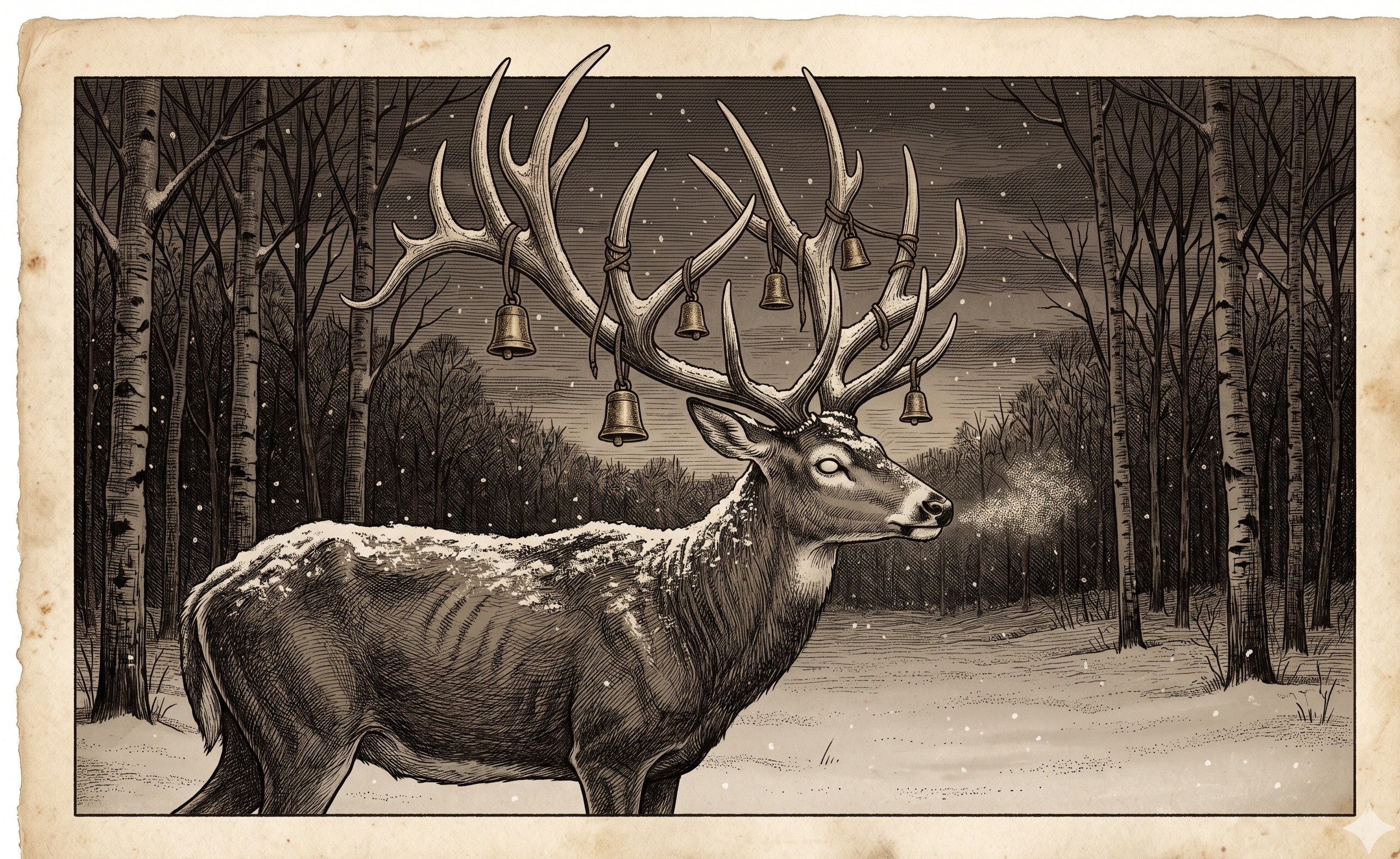
He walks the boreal forests of the northern Midwest in winter with small bells tied into his antlers. The bells do not ring on their own. They ring when something is about to die in the woods behind him, and the sound carries a distance it has no business carrying — sometimes eleven miles, across open lake ice, in a night so still the pines do not move.
The Rattlebone Stag is the first specimen in this bestiary that poses no direct threat to the witness. He does not pursue. He takes nothing. He cannot, by every account we have, even be seen to look at anyone who looks at him. He passes through a clearing, pauses, and walks on. What he is — what everyone in the logging counties of northern Michigan and Wisconsin has always agreed he is — is an announcement.
He is an announcement that has been wrong only four times on record.
The Origin Legend
The story that has survived in the clearest form was recorded by a retired schoolteacher named Elsie Korpela in 1938, who collected it from three separate old men in three separate counties in Michigan's Upper Peninsula, all of whom had heard it as boys. The agreement between the three versions was close enough that Korpela published them in parallel columns in a small county historical journal.
The story concerns a stag hunted in the winter of 1851 by a Finnish logger named Juho Lappalainen. Juho had tracked the stag for four days without killing it. On the fourth night, camped alone in a clearing, he heard the stag returning — not approaching him but pacing a wide circle around his fire, always at the edge of the treeline. Juho could hear the creature's hooves in the hard snow. But he could also hear, mixed in, a small and continuous metallic chiming.
At dawn he found the stag had left the circle and moved on. In the snow where it had paced he found six small bronze bells of a pattern he did not recognize. He took them home. Three weeks later his wife Kaarina, who had been pregnant with their second child, died in childbirth. The infant survived.
Juho returned to the clearing the following winter with the six bells. He did not bring a rifle. He tied the bells into the branch of a pine tree at the edge of the clearing and he spoke, in Finnish, to whatever was in the woods. What he said has not survived. What survived is the detail that when he left, the bells were no longer in the pine tree, and the nearest tracks in the snow around the tree were a stag's.
"He is not a warning. A warning assumes you can still do something. He is an announcement. You listen, you thank him, and you go home to the people while they are still there to be gone home to." — reported by an Ojibwe elder interviewed in Marquette County, Michigan, 1971
What Is Announced
Every account of the Stag in the historical record connects his appearance to a death that follows within a span of days — usually three to seven. The death is always within the community nearest to where he was seen, though "nearest" in the northern woods can mean thirty or forty miles, which is part of what makes the connection difficult to confirm in any strict sense.
The death is not usually tragic in the sudden sense. This is worth saying clearly, because the Stag's reputation is not as a creature of alarm. The deaths that follow his appearance are, as often as not, peaceful — old people in their beds, long-ill patients finally released, men who had been expected to go that winter simply going. Locals in the affected counties describe the Stag not as a herald of disaster but as an usher at a doorway. He is there because someone is passing through, and he is there to witness the passing. The bells are the sound of the doorway opening.
In Korpela's fieldwork she recorded the local expression, "the bells have been heard at the Laukkanen farm," used in the days leading up to the death of a very old woman in 1934 who had been in hospice care for two years. The family had been told her death was expected. The expression was not a warning. It was, her grandson explained to Korpela, "a kind of confirmation. It meant we could all come home now."
The four recorded cases in which the Stag appeared and no death followed within a month are treated in the folklore as errors on the part of the witnesses, not on the part of the Stag. Three of the four cases involved witnesses who had been drinking. The fourth is unexplained, and is treated — by people who collect these stories seriously — as a warning that he is not always consistent.
How He Appears
He is a white-tailed stag of approximately the size one would expect, if anything on the larger side. His coat is described always as winter-dark, almost black in most accounts, with a dusting of snow on the shoulders that never seems to melt. His eyes are pale — described variously as white, bone-colored, or "the color of an empty lake" — but he does not look at witnesses. This is consistent across two centuries of sightings. His gaze is always on the middle distance, as if following something only he can see.
The antlers are where every witness's eye goes first. They are enormous and branch too many times — twelve or fourteen points where a stag of his build would typically carry six or eight. And in the spaces between the branches are tied small bronze or brass bells, never fewer than six, never more than a dozen, attached with what appears to be plain leather cord.
The bells do not ring when he walks. This is the detail every surviving account emphasizes. He moves through deep snow, through windfall, through dense brush, and the bells are entirely silent. He is described moving in clearings and across frozen lake surfaces without making a sound. The silence is more unnerving than noise would have been.
When the bells do ring, they ring all at once, together, in a chord. Listeners describe the sound as unlike a sleigh bell and unlike a church bell. The closest comparison offered by the Ojibwe elder in Korpela's 1971 interview was "the sound of a small harness shaking off a horse that is no longer there."
Reported Encounters
A copper miner named Toivo Niemi, walking home across the ice of Portage Lake after a late shift, reported seeing a stag standing at the center of the ice approximately one hundred yards off his path. The stag did not move. Niemi walked on without stopping. Halfway to shore he heard the bells behind him — a single clear chord — and did not turn around. He arrived home to find his father, who had been ill for several weeks, had died approximately ten minutes before the bells rang. The family understood the timing. They had been waiting for it.
A logging crew of eleven men camped in a cutting near the Manitowish River reported being woken in the night by a chord of bells from the treeline, followed by the sight of a large stag passing through the camp at a walk. The stag paused once beside the dying cook fire, turned his head toward the sleeping men without looking at any of them, and walked on. Within six days, three members of the crew were dead — two in a log-rolling accident upriver, and one from pneumonia contracted, the survivors believed, in the cold snap that began that same week. The surviving men never worked that cutting again. It was eventually allowed to revert to forest.
A young National Forest ranger named Evie Wallace, conducting a winter wildlife count alone in the Ottawa National Forest, saw a stag standing in a clearing approximately forty yards ahead of her. She had been trained to look for specific antler configurations and immediately recognized that the branching pattern was not possible. She counted the points, recorded the sighting in her field notebook, and watched for approximately four minutes before the stag walked slowly out of the clearing without making a sound. No bells rang. Wallace thought little of it. Three days later her grandmother, whom she had never met and had not known was ill, died in a nursing home in Helsinki, Finland. Wallace was named in the will for a modest sum and a set of six small bronze bells of a family pattern she had never seen. She kept them. She did not wear them. The bells are now in the collection of the Ottawa National Forest Ranger Station archive, uncatalogued.
A hospice nurse named Dana Osterberg, driving home from a late shift in heavy snow, stopped her car when a large stag walked into the road in front of her and stood, not moving, looking past her vehicle. She could see the antlers in her headlights and, tied among them, six or seven small shapes that caught the light with a metallic gleam. The bells did not ring. The stag walked off. Osterberg waited approximately a full minute in the silence, then continued home. She arrived to a text message from her supervisor informing her that the patient she had left that afternoon — an elderly gentleman whose family had been at his bedside for two days — had passed peacefully approximately twenty minutes after she left. The time, she told a friend later, was about right. The stag had waited.
How to Respond
There is no rule for avoiding the Rattlebone Stag because there is no reason to avoid him. He is not, as every surviving source insists, a creature that can be fought, outrun, or escaped, because he is not a creature that comes for any individual. He comes for the doorway. The doorway is open regardless of whether he is witnessed.
What the folklore offers instead are what Korpela, in her quiet and careful way, called "courtesies." These are not protections. They are the right way to behave in the presence of a creature whose work is older than yours.
First: if you see him, stop walking. Do not continue on your path until he has moved out of sight or — if he is stationary — until you have stood still for long enough to feel that you have acknowledged him. A minute is usually sufficient. Two is better. What you are doing is witnessing. Witnessing is what he is for.
Second: do not attempt to count the bells. Multiple accounts include witnesses who tried to count and arrived at different numbers on successive glances. Whether this is a property of the Stag or a property of the witness in that moment is impossible to say. Either way, the count is understood by locals not to be for you.
Third: do not photograph, record, or draw him while he is present. This is the rule with the least folkloric justification and the most consistent modern adherence. No confirmed photograph of the Rattlebone Stag exists. Witnesses who attempted to take one report cameras failing, phones powering off, or — in one 2014 account — the photograph simply showing an empty clearing. Whether this is the Stag's doing or whether it is the kind of thing that tends to be true of such creatures generally, is a question Korpela declined to answer in her own work.
Fourth, and the courtesy most often forgotten: when you get home, call someone. Call whoever is oldest in your family, or whoever is sickest, or whoever you have not spoken to in too long. Do not tell them what you saw. Just call them and hear their voice. This is not a rule. It is what people in the northern counties do. They describe it, when asked, as "paying the bells forward."