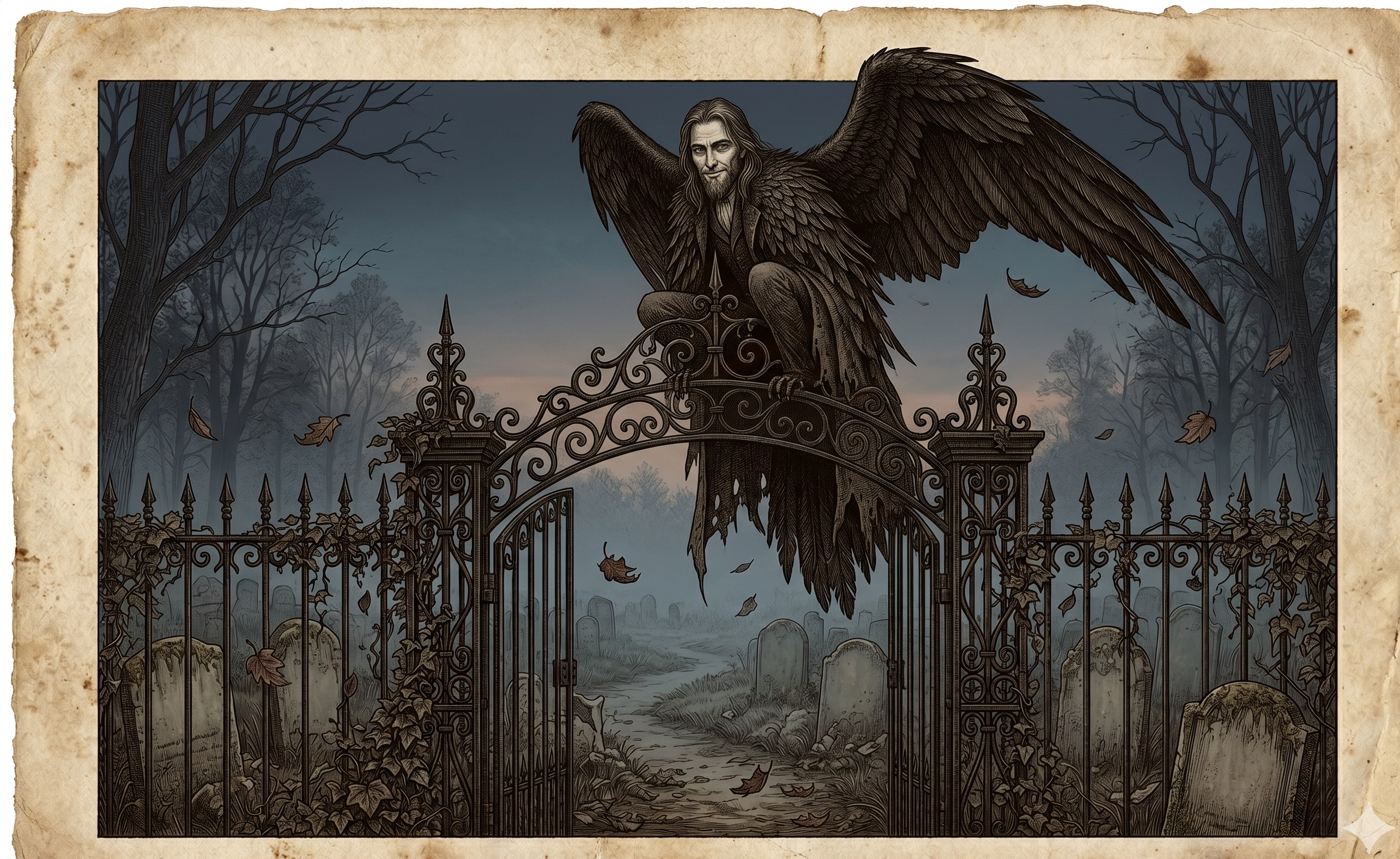
He perches on the wrought-iron gates of New England cemeteries at twilight, looks at whoever is passing, and smiles — a slight, companionable, knowing smile that is the most unbearable thing about him. He does not attack. He does not curse. He does not speak. He is the first specimen in this bestiary who is simply and completely an audience, and it turns out that an audience is enough.
What the Grinning Auspex is an audience for is the hardest part to explain. He does not appear to witnesses at random. Across two and a half centuries of surviving accounts, the pattern is ruthlessly consistent: he appears to a person who is, within the following twenty-four hours, going to make a decision they will regret for the rest of their life. Not a death. Not a tragedy inflicted from outside. A choice — theirs, freely made — that once made will not be unmade.
The witness does not always know, at the moment of sighting, what the decision will be. Many of them did not even know a decision was imminent. They learned, later, what the creature had been smiling about.
The Origin Legend
The earliest surviving mention appears in the private diary of Reverend Amos Thaxter, minister of the Second Parish of Truro, Massachusetts, dated October 1762. Thaxter recorded that three parishioners had come to him within a single fortnight reporting the same creature — a man-shaped figure with dark wings, perched on the gate of the Old South burying ground, smiling at them as they passed. Each of the three had subsequently made, in Thaxter's careful hand, "a choice of great injury to themselves or their families."
The first was a young woman who had called off an engagement that would have secured her family financially. The second was a shipmaster who had refused a cargo that would later be revealed to have been the most profitable of that year's trading season. The third was a father of six who had struck his own brother in an argument the men would carry for the remaining nineteen years of their lives without either of them ever apologizing.
Thaxter noted — and this is the detail his successors would spend the next two centuries trying and failing to disprove — that each of the three had seen the creature before making the choice, and each had described his expression as faintly encouraging.
The creature received his ecclesiastical nickname — the Grinning Auspex, from the Latin for diviner or seer of omens — from Thaxter's notebook, which circulated among New England clergymen after his death and was partially published, by a great-grandson, in the Massachusetts Antiquarian in 1891. The name has stuck.
"I asked him why he was smiling. He did not answer. He was not smiling at me. He was smiling at the thing I had not yet done." — diary entry, Providence Rhode Island schoolteacher, 1843, recovered 1912
What He Looks Like
The descriptions are remarkably consistent across two and a half centuries — more consistent than for any other specimen in this bestiary. He is tall. He is thin. He has the face and bearing of a man in his late thirties or early forties, handsome in an unremarkable way, the kind of face a witness would have trouble picking out of a crowd the following day. His hair is dark and slightly long. He wears dark clothes of indeterminate period — witnesses from the 1780s described him as dressed similarly to themselves, and so did witnesses from the 1990s, and the descriptions from the two eras do not match.
The wings are large, dark, and avian — variously compared to a raven's, a crow's, a vulture's. They are folded half-open when he is at rest, fully spread at the moment before he leaves. They do not look costumed or ornamental. Several witnesses have reported being close enough to see individual feathers in detail, and none of them have ever described those feathers as anything other than real.
His eyes are the detail every account returns to. They are pale grey. They do not blink. And they are always, without exception, looking directly at the witness. Not past them, not through them. At them.
The smile is small. It is closed-mouth. It is the kind of smile a man makes when he is watching a friend do something moderately embarrassing and is too polite to say so — and just amused enough to be unable to look away. Witnesses describe it, almost universally, as feeling companionable, as if he is sharing a joke with them. The horror of the smile comes afterwards, when they realize what the joke was about.
How He Knows
This is the part of the Grinning Auspex's lore that has generated the most commentary among the region's folklorists. Reverend Pell spent most of his career on this single question and never arrived at a clean answer. The creature is not a prophet. He does not speak, deliver warnings, or offer advice. He is not a tempter — witnesses who saw him before making a bad decision report no sense of external pressure or persuasion. The decision is always, unambiguously, theirs. He is simply present for it.
What he seems to do — or what Pell, cautiously, concluded he seems to do — is know the outcome in advance. Not cause it. Not influence it. Know it. He appears when the outcome is already effectively settled, even when the decision has not yet been consciously made, and he watches because watching is what he is for. Pell's phrase, written in the margin of his working notebook in 1898, was that the Auspex is "a witness the universe has appointed for certain of its smaller tragedies."
Whether this is satisfying as a theory is another question. A creature that shows up only for decisions that are already cooked is, at best, a minor cosmological bureaucrat. What makes him disturbing is not his mechanism. It is the specific emotional register of his smile — the fact that he knows what is coming, finds it mildly amusing in the way a bystander might find a long slow pratfall mildly amusing, and is not going to tell you.
Reported Encounters
A young silversmith named Thomas Hovey, walking home past the Granary burying ground after an evening of drinking with friends, saw a winged figure perched on the cemetery's iron gate, smiling at him. Hovey was sober enough to remember the encounter. He was also sober enough, the following afternoon, to sign his name to a partnership agreement with a business acquaintance his wife had repeatedly begged him not to trust. The partner absconded with the firm's capital within eighteen months. Hovey never recovered. He spent the last decade of his life telling the cemetery story to anyone who would listen, and it is from his repeated telling — recorded by a nephew in 1832 — that we have the first detailed account of the creature's physical appearance.
A twenty-six-year-old newspaperman named Eldridge Cavanagh, passing the Swan Point gate on his way home from a late editorial meeting, saw a man with dark wings sitting on the upper crossbar, looking at him with what he later described as "the expression of an old friend who is about to see me embarrass myself." Cavanagh went home, could not sleep, and at approximately three in the morning sat down and wrote a letter to his fiancée ending their engagement. He did not post it until the following afternoon. By the time he tried to retrieve the letter from the post office two days later, it had been delivered. He did not marry. He lived another forty-seven years, and when interviewed in old age by Reverend Pell in 1934, he would only say that the creature had been "correct, in a way I have come to find unkind."
A Korean War veteran named Frank Kowalski, recently returned home and walking through the North End on a cold evening, saw a figure with dark wings standing atop the Copp's Hill gate. Kowalski, who had seen far worse in the previous two years, did not run. He walked to the gate and stood looking up at the creature for what he later estimated to be two or three minutes. The creature smiled at him. Kowalski asked, aloud, "what am I about to do?" The creature did not answer. Kowalski walked home. Three days later, in what he always described as "the first and only time I ever hit a woman," he slapped his mother during an argument about his plans to marry a girl she disapproved of. He married the girl anyway. The marriage lasted forty-one years. His mother never forgave him for the slap and did not attend the wedding. Kowalski, in an oral history recorded in 1997, said he has always believed the creature was smiling at the slap, not the marriage, and that this belief has been "the one small comfort of the whole episode."
A twenty-eight-year-old financial analyst named Priya Ramachandran, crossing the Common on her way to meet a colleague for drinks, saw a winged figure on the gate of the Central Burying Ground. She took her phone out reflexively and attempted to photograph him. Her phone powered off. When she looked up, the figure was gone. She met her colleague for drinks. Approximately two hours later, at the bar, she said something to him that — in her own words, recorded by a friend who was there — "I knew, even as it was leaving my mouth, would end my career at that firm and probably in that industry." It did. Ramachandran now works in a different field, considers the career change to have been a significant net improvement for her life, and has told the cemetery story to enough people that it eventually reached a folklorist who had been following the Grinning Auspex accounts as they appeared in contemporary oral culture. Hers is the first recorded encounter in which the witness has, in retrospect, been glad of the decision.
How to Respond
There is, as with the Rattlebone Stag, no means of avoiding the Grinning Auspex and no reason to. He does not pursue. He does not haunt. He appears where he appears, and the witness who sees him was going to be the witness he was waiting for regardless. What the folklore offers is not avoidance but preparation — three considerations that survivors and scholars, especially Reverend Pell, have suggested.
First: if you see him, go home. Do not continue on to your evening's business, whatever it was. Do not meet the friend. Do not attend the dinner. Do not sign the contract. Do not send the letter. The decision is coming within the following day. It does not have to be made tonight. Postponement is always available and is, according to the folklore, the one action that sometimes — not always, but sometimes — changes the shape of the thing enough that the creature's prediction becomes inaccurate. Reverend Pell's notes contain seven cases in which a witness saw the Auspex, went directly home, went to bed, and reported no life-altering regret within the following week. Pell did not consider this a reliable cure. But he considered it the best we have.
Second: do not ask him. Kowalski tried, in 1952. He received no answer, and he later speculated that even if he had received an answer, he would have made the choice anyway. The folklore confirms this. Several witnesses have asked the creature what he is smiling about. None have reported a response. Pell's hypothesis — which he called "the courtesy hypothesis" — was that the Auspex does not speak because the one thing he could say, if he said it, would rob the witness of the dignity of making the decision freely. The smile is the most he is permitted to do.
Third: when the decision comes, whatever it is, make it slowly. Take the day. Walk around the block. Read the contract twice. Answer the letter tomorrow. This is not a rule against action. It is a rule against the speed at which bad decisions are made. Every encounter on record that led to a regretted choice was a choice made within twenty-four hours of the sighting, and most were made within six. Pell noted in 1921 that "the grin gives the witness permission to be hasty, and the haste is what the grin is really about."
If you take the long route — the slow one, the one where you sleep on it, the one where you say I will decide on Thursday and then on Thursday you decide — Pell believed you were, at minimum, depriving the creature of a clean viewing.