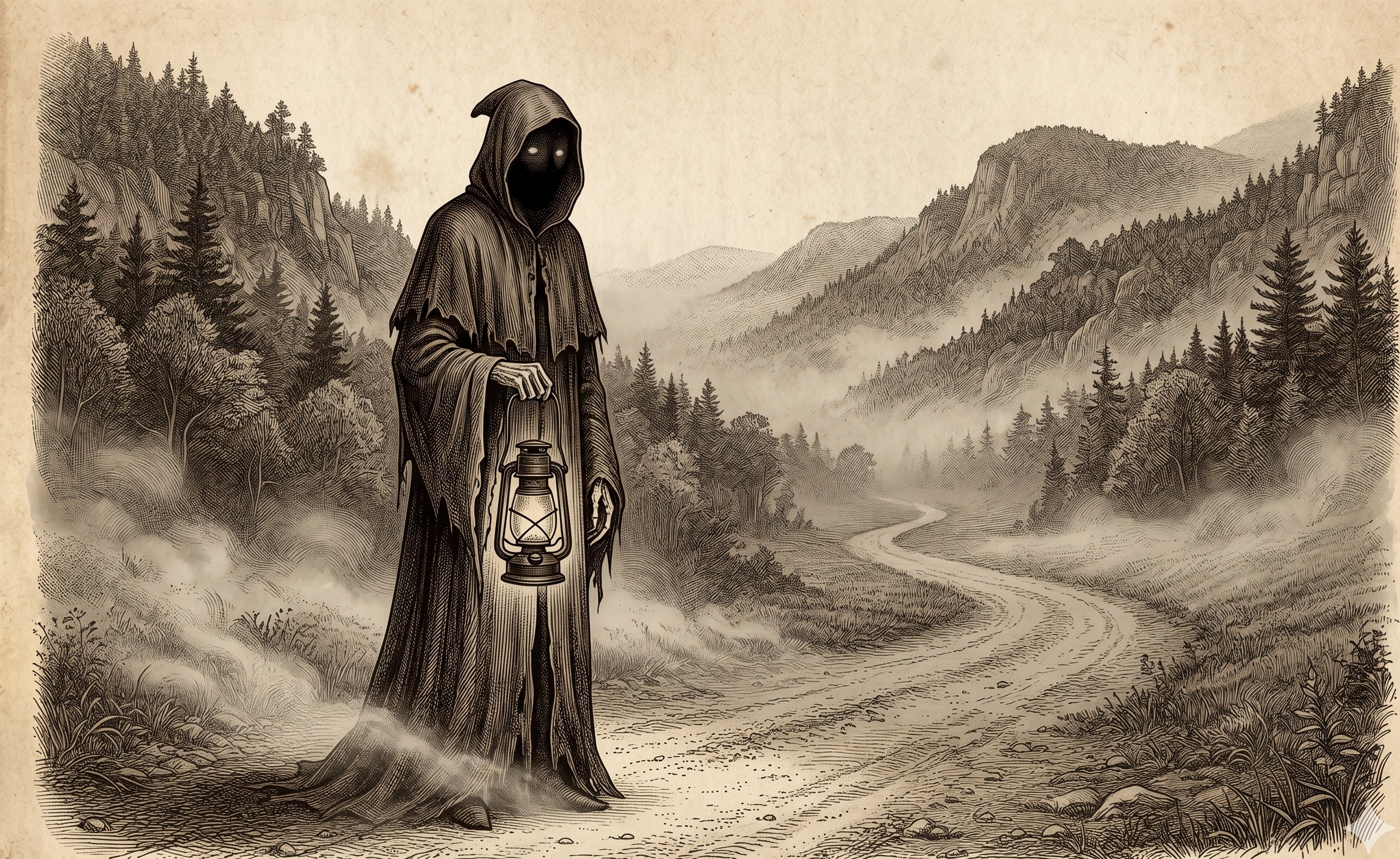
He walks the old mail roads of West Virginia carrying a lantern with no flame. The locals have a saying for those who encounter him: do not count his steps. For every step you number, a year is taken from you — given back only when another counts in your place.
This is the first catalogued specimen of the Monster Articles bestiary, and an appropriate one, because he is a creature almost entirely made of the act of being witnessed. The Hollow Pilgrim does no harm by tooth or claw. He cannot, in fact, be touched. Those who have tried report only that their hands pass through a cold patch of air and come away smelling faintly of pine resin and old paper.
What he does instead is worse, in its way. He invites the act of observation, and charges for it.
The Origin Legend
The oldest account traces his appearance to the winter of 1820, in the unsettled backcountry of what was then western Virginia. A circuit-riding postman named Eli Harrow set out from a mountain trading post bearing letters for four families and was never seen again. His mule returned without him three days later, the mailbag empty.
Some said wolves. Some said a fall. But by the following spring, travelers on that same road began reporting a figure ahead of them in the half-light — tall, cloaked, carrying a lantern that gave no glow. He walked always at the same distance, always away. Those who quickened their pace found the gap between them did not close. Those who slowed found he waited.
The families whose letters he had carried were the first to understand. A cousin in Lewisburg reported seeing her missing brother's handwriting — but not in ink. The shape of each letter had been traced into the frost on her windowpane, one word per morning, for eleven mornings. On the twelfth morning, the frost showed only her own name, and the window was never frosted again.
"I would not say the pilgrim is cruel. He is, so far as I can tell, doing his rounds. The trouble is that he has forgotten where the rounds were supposed to end." — reported by a retired Baptist minister, Pocahontas County, 1974
What He Looks Like
Reports vary on almost every detail — height has been given as anywhere from six to nine feet — but three features appear consistently across two centuries of accounts. The first is the hood. He wears a long traveling cloak with the hood drawn forward, and no account has ever been able to describe what is inside it. Witnesses who are pressed tend to say only "nothing that answered," which is not an answer but a kind of flinch.
The second is the lantern. It is always present. It is always held at waist height. It is never lit, and yet — in several accounts, including one from a Kentucky sheriff in 1938 — the ground for a small radius around him appears slightly brighter than it should, as if the darkness itself were made thinner nearby. A Welsh folklorist who studied the accounts in the 1970s called this "negative illumination," and the phrase has entered the local vocabulary.
The third is the walk. It is slow, unhurried, and wrong. Witnesses struggle to explain what is wrong about it. Several have independently described it as "the walk of someone who has just stopped counting."
How He Hunts
The Hollow Pilgrim does not pursue. He appears already present — ahead on the road, at the bend of a creek, at the edge of a field at dusk. He cannot be avoided by choosing a different route. If you are going to see him that night, you will, and the choice of road will only change where.
He poses no threat until the moment the witness attempts to count. To measure. To quantify. This may be the number of his steps, the distance between you, the minutes he has been visible. The act of enumeration is the threshold. The year is taken quietly — a birthday skipped, a decade appearing in the mirror overnight, a photograph that shows more white in the hair than the mirror did yesterday.
The years are not destroyed. They are held. This is the important part. A taken year can be returned — but only by another person counting in the first person's place, in the same spot, on the same road, within a year of the original encounter. Locals who know the stories have, on several documented occasions, gone out deliberately to the place where a friend or spouse saw the pilgrim, and counted for them. The lost years come back in a rush, sometimes within hours. The counter typically loses the equivalent number of days.
Reported Encounters
A young schoolteacher named Ada Craddock walking home from a one-room schoolhouse reported a tall figure ahead of her on the Huntersville Turnpike, carrying an unlit lantern. She was twenty-three years old when she saw him. By the time she arrived home forty minutes later — a walk she had made a hundred times — she was, by her own account and her mother's, thirty-one. Her mother recognized her only by her voice.
Two CCC workers returning to camp after dark reported a cloaked figure approximately two hundred yards down the fire road. One of them, a lumberman named Hollis Berryman, instinctively began counting paces — he made it to fourteen before his companion struck his arm. Berryman's hair was fully white by breakfast the following morning. His companion lost no years at all. Berryman lived another thirty-eight years in evident good health, but he refused ever again to count anything aloud.
A folklore graduate student from West Virginia University, driving alone at dusk, saw a figure matching every detail of the accounts she had spent the summer collecting. She pulled over and, aware of the rules, deliberately did not count anything. She sat in her car for approximately forty minutes, not counting, until the figure was gone. When she resumed driving she found her odometer had advanced seventy-three miles, though the road she had traveled was eleven miles long. She finished her dissertation. She did not write about the pilgrim.
A father and his ten-year-old son, walking a family dog, saw a lantern-bearing figure at the end of a long fenceline. The father, who had grown up in the area and knew the story, put his hand over his son's mouth and did not speak a word for seven minutes. The figure vanished when they turned and walked away. The dog, however, had begun barking and did not stop. The dog was twelve years old that evening. By the following morning it was twenty, and died peacefully of old age in its bed three days later.
How to Avoid Him
Highland residents who pass the story down give four rules, in this order, and insist that they are in the correct order because the last one is the one that most often fails.
First: do not look directly at the lantern. The lantern is the part of him that wants to be observed. Peripheral vision is safer, and in most accounts witnesses report being unable to look at the lantern for long anyway, as the "negative illumination" makes the eyes tire.
Second: do not count. Not steps, not minutes, not the distance to the next mile marker, not the cars in the opposite lane, not anything. If you must occupy your mind, recite something you have memorized. A prayer, a poem, the alphabet — but not counting-rhymes, of which Appalachian folklore has many, and any of which will do for him.
Third: do not turn back. Turning back is itself a kind of counting — a subtraction of the distance you have already traveled. Continue forward. Take a different road only at the next natural intersection.
Fourth, and hardest: do not tell anyone about him until morning. Speaking of him in the hours he is active is understood to be a form of invitation. The morning comes, the rule ends, and the story may then be told. This is why, the locals say, you will not meet a West Virginian who speaks of the pilgrim after sundown, but will meet several willing to tell you everything at breakfast.