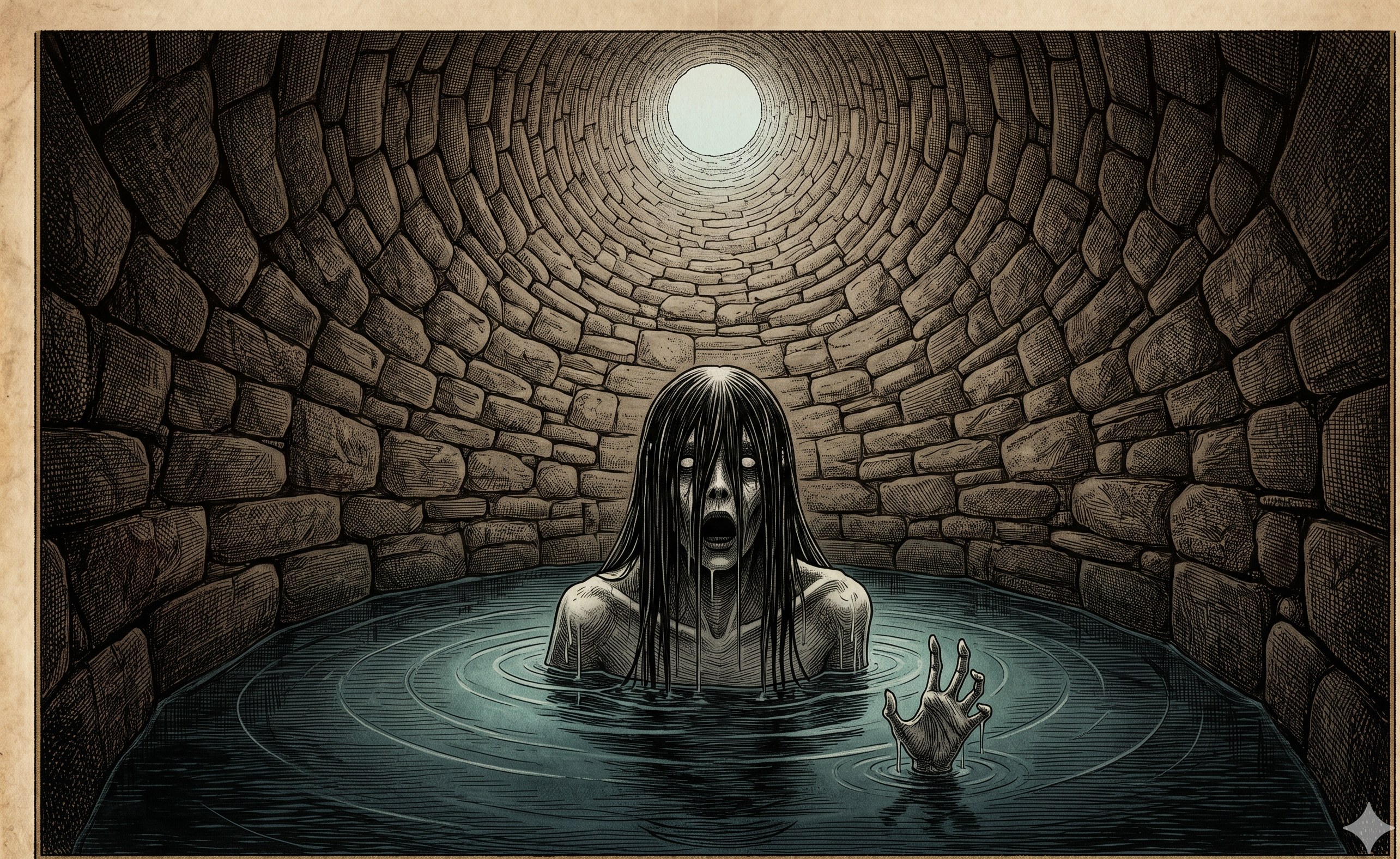
She lives in abandoned rain cisterns and dry wells throughout the rural American South, and she calls in the voice of a woman looking for her drowned son. The call is the trap. The call is also, by every surviving account, impossible to refuse to answer.
Where the Hollow Pilgrim works by the rule of silence — by forbidding the witness to count — the Cistern Widow works by its inverse. She compels a response. She is a creature of unfinished grief, and what she requires from anyone close enough to hear her is a single spoken word. Any word. She does not care which.
She is, by the count of the farmhouse folklorist Etta Burrage who spent forty-one years collecting these accounts across Mississippi, Arkansas, and northern Louisiana, the most active specimen in the American bestiary. Burrage catalogued sixty-seven encounters before her death in 1987. Only forty-two of the witnesses remained alive to be interviewed.
The Origin Legend
The most repeated story — and the oldest, in the form we now know it — concerns a woman named Marthe Devereux, a French-speaking farmwife who lived with her husband and infant son on a small cotton parcel near what is now Tallulah, Louisiana. The year was 1898 or 1899 depending on which account you credit. In the summer of either year, during a week of hard rain, the Devereux infant was found drowned in the family's brick rain cistern.
Marthe, who had been hanging laundry when it happened, refused to accept that the child was gone. For thirteen nights after the burial she went out to the cistern with a lantern and called into it, in French, for her son to come home. On the fourteenth night she climbed in.
Her husband found the cistern lid ajar the next morning, and the water undisturbed. No body was recovered. The cistern was sealed over with fieldstones and mortar, and the Devereux family moved west within the year. The cotton parcel was abandoned. The cistern, according to three separate accounts from people who tried to find it in later years, could not be located.
But within a decade, other cisterns across the Delta began to report a voice.
"She does not call your name. She calls the name of whoever she has lost. She is always calling. She has never stopped. I do not think she knows he is dead." — reported by Etta Burrage, interview with an Arkansas field hand, 1964
How She Sounds
Witnesses describe the voice with more consistency than almost any other detail. It is always the voice of a woman. It is always calling a child's name, though the name changes from region to region and sometimes, within the same county, from night to night. It does not echo, which is the oddest part. A voice from a cistern should echo. Hers is close, as if whispered from six inches away, regardless of the cistern's depth.
The emotional register never varies. It is not frantic. It is not mournful. It is the voice of a woman who has been calling for an hour and expects to be calling for an hour more, and will not stop in either direction. Burrage noted in her fieldwork that this steadiness is what makes the voice so difficult to dismiss as imagination. Imagined voices rise and fall. The Widow's does not.
Those who have heard her and survived without answering describe a strong, almost muscular compulsion to respond. Several have said they found themselves opening their mouths without deciding to. One Missouri sheriff, who heard her twice in his life and did not answer either time, told Burrage in 1971 that he accomplished this only by biting the inside of his cheek until it bled. The bleeding, he said, "gave the mouth something else to do."
What Happens If You Answer
She does not take you into the water. This is the first thing to understand, and it is the thing that misleads most accounts. She does not drag. She does not pull. The Cistern Widow is not a physical predator.
What she takes is the name she was calling. If you answer her — any word, any syllable, even a throat-clear loud enough to be a reply — the name she was calling becomes permanently unavailable to you. You will not be able to say it. You will not be able to write it. You will not be able to hear it said without a sensation described by survivors as a cold hand placed gently on the back of the neck.
This would be a minor curse, if the name she called were a name you did not know. But the compulsion to respond is partly caused by the fact that, at the moment she calls, the name is always one the witness is able to recognize. A grandmother's name. A child's name. A sibling who died young. The name of a friend you have not spoken to in thirty years and who you were, until this moment, perfectly able to name.
After the encounter, that name is gone from you. The person associated with the name remains — you know they existed, you know what they looked like, you know what they meant to you — but their name is a hole in the center of your memory, and a hole that cannot be refilled by being told the name by someone else. You will hear it said. You will understand that it was just said. You will be unable to repeat it.
Reported Encounters
A levee worker named Corbin Pearce, walking home past an abandoned farmhouse after his shift, heard a woman's voice calling the name "Henry" from an old cistern behind the barn. Pearce had a younger brother named Henry who had died of influenza six years earlier. He answered, without meaning to, with the word "coming." By the following morning he could not remember his brother's name. He remembered everything else — the illness, the funeral, the grave — but the name itself had been, as he later put it to Burrage, "taken out of me like a stone out of a boot." He lived fifty-one more years and never recovered it.
Two teenage girls, cousins named Ruby and Imogene Blanchard, heard the voice while camped near a collapsed well on their grandfather's farm. The voice called the name "Imogene" — which is, notably, one of the cousins' own names. Imogene Blanchard answered, believing at first that her cousin was playing a trick. She reported afterward that she could no longer say her own name, and spent the remainder of her life, another sixty-three years, going by her middle name. She could hear "Imogene" said aloud. She could not produce the word with her own mouth. Ruby Blanchard, standing next to her, was unaffected, but reported that she could not ever afterward bring herself to say her cousin's first name either, "out of respect."
A county well-inspector named Alton Harlow lowered a work light into a fieldstone cistern on a foreclosed property and heard a voice calling "Samuel." Harlow's wife had lost a son named Samuel in infancy fourteen years earlier. Harlow, an experienced and careful man who had heard the Widow stories all his life, bit down on his tongue and did not answer. He successfully climbed out of the cistern without speaking a word. He drove home in silence, entered his house in silence, and kissed his wife on the forehead without speaking. She asked him what was wrong. He could not answer. He did not speak again, in fact, for three weeks, because he was afraid the first word he said would be the name. When he finally did speak, it was the word "supper," and the name was fine. He was the most cautious man in Madison Parish for the rest of his life.
A real-estate agent showing an abandoned plantation property to a prospective buyer heard a voice from an overgrown cistern calling a name the agent did not recognize. The buyer, however, did. The buyer answered immediately — reflexively — and then went silent for the remainder of the tour. He bought the property anyway. He had the cistern filled with concrete within a week of closing. When later asked, by a nephew, about his mother — whose name had been the name called — the buyer was able to describe her in perfect detail but could not produce her name, and said only, "she was my mother." This is how the encounter came to be catalogued. The nephew was a folklorist.
How to Avoid Her
First: do not approach any cistern, well, rainwater collection, or standing water in an abandoned structure between the hours of 2 a.m. and 5 a.m., particularly during or shortly after the full moon. The Widow is believed to be most active in these hours. She has been reported outside these hours, but rarely.
Second: if you hear a voice calling a name you recognize, do not answer. Not with speech, not with a cough, not with a hum, not with a whistled acknowledgement. Close your mouth and keep it closed until you are at least a quarter mile from the water source.
Third: do not attempt to see her. The sighting is not the dangerous part — the hearing is. But witnesses who have tried to see her report that the visual compounds the auditory compulsion, and that answering becomes nearly involuntary.
Fourth: if the voice is calling a name you do not recognize at first but which you begin to recognize as you listen, leave immediately. The recognition is her hunting mechanism. She is matching names to listeners. If you stay, she will find one.
Fifth, and the rule Burrage called "the quiet rule": do not speak of her in the presence of standing water. This includes bathtubs, kitchen sinks, ornamental ponds, and any glass of water on the table in front of you. The stories say she listens through water, generally, and that a sufficient pool of it in a quiet house can serve as a small and unworthy cistern. Whether this is true or whether it is the kind of thing people say to make children drink their glass at dinner, Burrage did not claim to know.