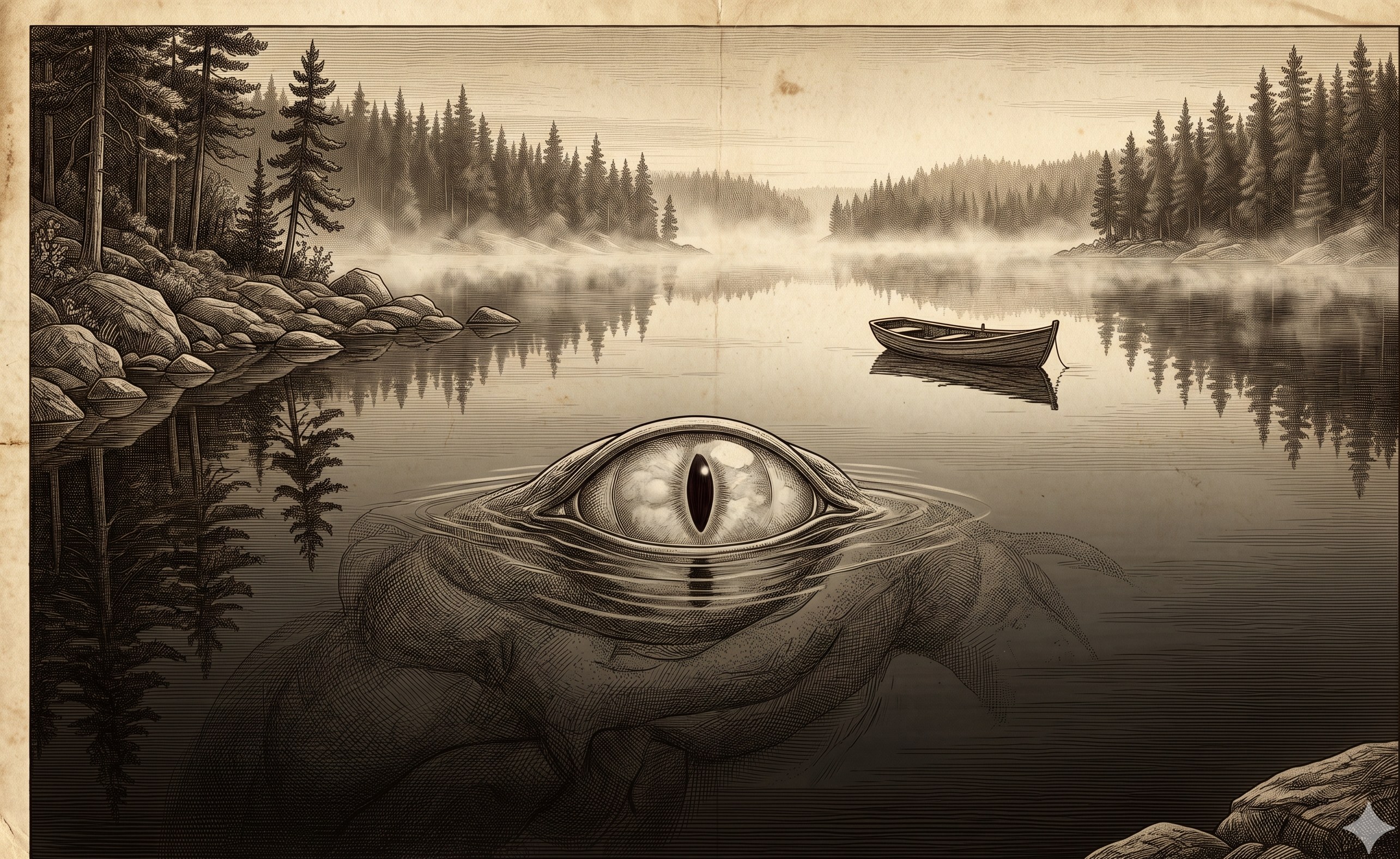
At dawn, on certain glacial lakes in the western Adirondacks — always before the wind has come up, always when the water is mirror-still — a single enormous pale eye rises just to the surface and looks at the shore. Whatever it sees, the fishermen say, is afterward always in shadow.
The Lake-Eye of Elswick is the first specimen in this bestiary for which we cannot say, with any confidence, what the threat is. Witnesses report no physical harm. No taken years, no stolen names, no compelled responses, no announced deaths, no regretted choices. What they report is a feeling — sometimes faint, sometimes not — that a particular object, person, or place they were looking at that morning has been marked. Photographed. Filed. And that the filing was not done by them.
What comes of the marking, if anything comes, is the part of the lore that refuses to cohere. This is the entry I have put off writing the longest, for that reason. It is not a creature you catalogue so much as one you admit, eventually, that you cannot.
The Origin Legend
The earliest account associated with the Lake-Eye comes from the hamlet of Elswick, New York — now a ghost settlement of five foundations and a single surviving chimney on the southeastern shore of what the U.S. Geological Survey currently calls Raggedy Pond and what the locals, when there were locals, called Looking Water. The year is probably 1827 or 1828. The account comes from a logger named Silas Durment, as related to his granddaughter fifty years later.
Durment, according to the family account, had gone out to the lake before dawn to retrieve a trap he had set the previous evening. The lake was still. He rowed out approximately a hundred yards and found his trap empty. On the row back to shore, he happened to glance down at the water beside his boat and saw, three feet below the surface, a pale eye the size of a wagon wheel, looking up at him. The eye did not blink. It did not follow. It was simply there, beside his boat, all the way back to shore. When he stepped out onto the dock he looked back once. The lake was empty.
Durment is said to have been unaffected by the encounter for approximately six weeks. Then, at the end of October of that year, the hamlet of Elswick — all thirty-one of its residents — packed up and left, as far as can be determined, without coordinating with one another and without any single apparent cause. Durment's granddaughter, interviewed in 1879, said only that her grandfather had told her "the lake had seen too much of us."
What this means is not clear. What is clear is that the settlement never recovered, the lake was renamed, and the creature was not catalogued for another seventy years.
"I will be honest with the reader. I have spent eight summers on these lakes, and I have seen the eye twice, and I still cannot tell you what it does. It is not the unknowing that troubles me. It is that the unknowing is, I am slowly coming to believe, the thing itself." — Rev. Josiah Pell, field notebook, July 1909
What Witnesses See
Every account on record agrees on the basic geometry. The Lake-Eye is a single eye — never two — approximately four to six feet across at its widest point. It is roughly almond-shaped, with a pale, clouded, milky iris and a dark vertical slit of a pupil that is always fully contracted, as if perpetually responding to light that is not actually present. The iris itself emits a faint paleness that witnesses describe as making the surrounding water appear slightly brighter than it should be, at least in the immediate vicinity of the eye.
The eye always appears at, or just below, the surface of the water. It never rises above. It never submerges fully enough to disappear. The dark shape suggested beneath it — described by the few witnesses who have looked — is massive, amorphous, and does not resemble a body. Rev. Pell, who was a careful observer, wrote in 1909 that the shape "suggests a larger creature only in the way that a page suggests a book. You do not see the book. You infer it."
The eye does not follow a witness. It does not track. Witnesses who have moved — walked along the shore, paddled past, driven a car along a lakeside road — have reported that the eye simply remains where it is, looking where it was looking when they first saw it. Whatever it is looking at, it is not them.
This is the detail that has tormented the creature's scholars. The eye is not aimed at the witness. The witness is merely adjacent.
What It Does
This is the section of the article that Rev. Pell could not finish writing. He began five separate manuscripts about the Lake-Eye between 1908 and his death in 1937, and none of the five progressed past what he called "the admission that I am out of my depth." The surviving pages are in the archives of the Regis College Divinity Library, where I have spent two afternoons not entirely sure what I was looking at.
The consistent element across all surviving witness accounts is a feeling — not an experience, not an outcome, a feeling — that a particular something the witness had been looking at that morning has afterward been placed, subtly, in shadow. A particular grove of birch. A particular outbuilding on a particular farm. A particular person. Not darkened physically. Not harmed. Placed in shadow.
Pell's best articulation of this feeling, from the 1919 manuscript fragment: "It is as though the eye, looking where I had been looking, has taken my looking from me. The thing is still there. I can still see it. But I can no longer see it the way I saw it yesterday. It has been — there is no other word, and the word is wrong — catalogued by something other than me."
Pell struggled with this because it is not a concrete harm. Witnesses who have reported the marking have gone on to live otherwise unremarkable lives. The farm is still the farm. The grove is still the grove. But there is a diminishment. A subtle unchildwhatever-ing. Pell called it, in the last of the five fragments, "the loss of the first look." A witness who has seen the eye can never again see the objects it saw with them in the way they saw them before.
Whether this constitutes a threat depends, as Pell eventually wrote in 1934, "on how much you valued your first look."
Reported Encounters
Silas Durment, logger. Saw the eye beside his rowboat at dawn. Accompanied him to shore, did not submerge, did not surface, simply ceased to be visible at the moment his boots touched the dock. The hamlet of Elswick dissolved within six weeks. Durment lived another forty-two years in a different county and, by family account, never again willingly looked at standing water of any kind. Asked on his deathbed what he thought the eye had seen, he is reported to have answered: "the town. The town, mostly."
Rev. Josiah Pell himself, during the third of his eight documented summers in the Adirondacks. Pell was conducting what he called "a patient watching" on the eastern shore of Indian Lake, having heard accounts of the Lake-Eye appearing there from three separate local guides. At 5:47 a.m. on the morning of August 19, 1909, the eye appeared approximately ninety yards offshore, remained visible for — by Pell's pocket watch — fourteen minutes and forty-one seconds, and then was no longer there. Pell had been looking, during those fourteen minutes, at an Adirondack lean-to on the opposite shore. The lean-to was torn down the following summer for reasons no one involved in the decision could afterward articulate. Pell visited the site. He said, in a letter to a colleague: "the clearing is still there. It is not the clearing I watched."
A young photographer named Delia Krantz, who had been contracted by the Adirondack Park Agency to document shoreline erosion, set up a large-format field camera at dawn on a small cove north of the Sacandaga. She was attempting to photograph the morning mist rising from the water. Through the camera's viewfinder, approximately forty feet offshore, she saw the eye. She took the photograph. The photograph, when developed, showed only still water and mist. Krantz was certain enough of what she had seen that she called the Agency and asked whether the project could be reassigned. It was. Krantz never again photographed a body of water. She told the story only once on the record, to a folklore graduate student in 1991, and said afterward that she had been "photographing something I had no right to photograph, and I think it knew, and I think it took the picture anyway."
A father and daughter on a camping trip, the daughter being eight years old. The daughter, waking earlier than her father, walked down to the lake at dawn to see it in the mist. She came back to the tent and told her father, calmly, that "there was a big eye in the water, looking at the other side." Her father did not go to check. He packed up the tent. They left the campsite by 7:30 a.m. The daughter, now fifteen years old at the time of this writing, has been asked about the encounter twice — once by a family friend who is a folklorist, and once by me, with her father's permission. She has no trouble remembering it. She remembers the eye. She also remembers what the eye was looking at. It was looking, she said, at the chimney of the old foundation on the opposite shore. The chimney is still there. She has since declined to look at photographs of it. She will not explain why.
A fifth encounter exists in Pell's papers but is incomplete — a woman in 1931, near Lake George, whose sighting is referenced in two separate letters Pell wrote but whose name and circumstance Pell never recorded. He seems to have been in the process of interviewing her. The interview was not completed. Pell noted only, in the margin of his final working notebook, that the woman "declined to continue. I do not blame her."
How to Respond
The Lake-Eye cannot be fought, outrun, or petitioned, because whatever it is doing is not being done to the witness. The witness is, in Pell's phrase, "merely nearby." What the folklore offers are three small observances — similar in spirit to those proposed for the Rattlebone Stag, with which the Lake-Eye shares a quiet kinship.
First: if you see it, close your eyes. Not out of superstition — out of strategic charity. Whatever the eye is looking at, it is presumably looking at whatever your own eyes are also looking at, a moment before or a moment after. If you close your eyes, you reduce — by a small but nonzero amount — the number of things you will share in the looking. Pell believed this made a difference. He did not claim to be sure.
Second: do not photograph, record, or sketch what you see. This is a folkloric rule rather than a practical one. Photographs do not seem to capture the eye, as Krantz's 1967 encounter established. But the rule, which predates Krantz by at least a century, suggests that the attempt itself is understood by local tradition to be a kind of offering — you are handing the eye a second witness, which is to say, your own apparatus of looking. The lore is not specific about what this costs. It suggests only that you should not give it.
Third: after the encounter, go somewhere you have never been. This is Pell's rule, proposed in 1934 and never subsequently revised. His reasoning is quiet. The Lake-Eye has, in his account, taken the first look from certain of the places and things you saw that morning. You still have the first look for other places and things. Go see them. Do not spend the rest of the day walking the same shoreline. Do not spend the next week rewalking the paths you saw at dawn. Go somewhere your eye has not been. "We are," Pell wrote in the final paragraph of the 1934 fragment, "possessed of a limited number of first looks. It is the business of a life to spend them gently, and the work of a careful man to spend them somewhere new."
The Pages the Machine Left Blank
The Lake-Eye is the first entry where the machine refused to finish a section in the way I had asked. I asked it, on the first draft, to write a clean mechanism — a rule, like the Pilgrim's counting or the Widow's answer, that the witness could understand and avoid. It wrote four attempts, and on the fifth it stopped and said that the creature it was trying to describe was a creature whose mechanism could not be specified without lying.
I pushed back. I told the machine this was a bestiary, and a bestiary entry needs a mechanism; readers have expectations. The machine said the expectations were mine, not the readers'. It said that if I read the four previous entries honestly, I had been training the reader to expect that every specimen could be catalogued, and that the quiet promise of a folklore tradition is that some creatures cannot be. It said a bestiary that never admitted this would be, in the long run, less trustworthy than one that occasionally did.
I thought about this for a long time. I ended up letting the machine write the entry the way it wanted to, which is why the "What It Does" section resolves into a feeling rather than a rule, and why Rev. Pell's manuscripts remain unfinished in the fiction. The encounter with Delia Krantz and the eight-year-old daughter in the 2019 encounter both came from the machine unprompted; I had asked for four encounters and given no specifics about what they should contain.
The machine's last suggestion, which I have followed, was that the Lake-Eye's threat level should read Unknown rather than Moderate or Low. It said that the bestiary would benefit from having a single entry in which we admit, on the record, that we do not know. It said future entries would feel more honest for it.
I think it is right. I am not sure it is right. I am leaving it this way.
Further Reading from the Library
Some links above are Amazon Associates links. A small commission supports the bestiary. It does not change what gets catalogued.