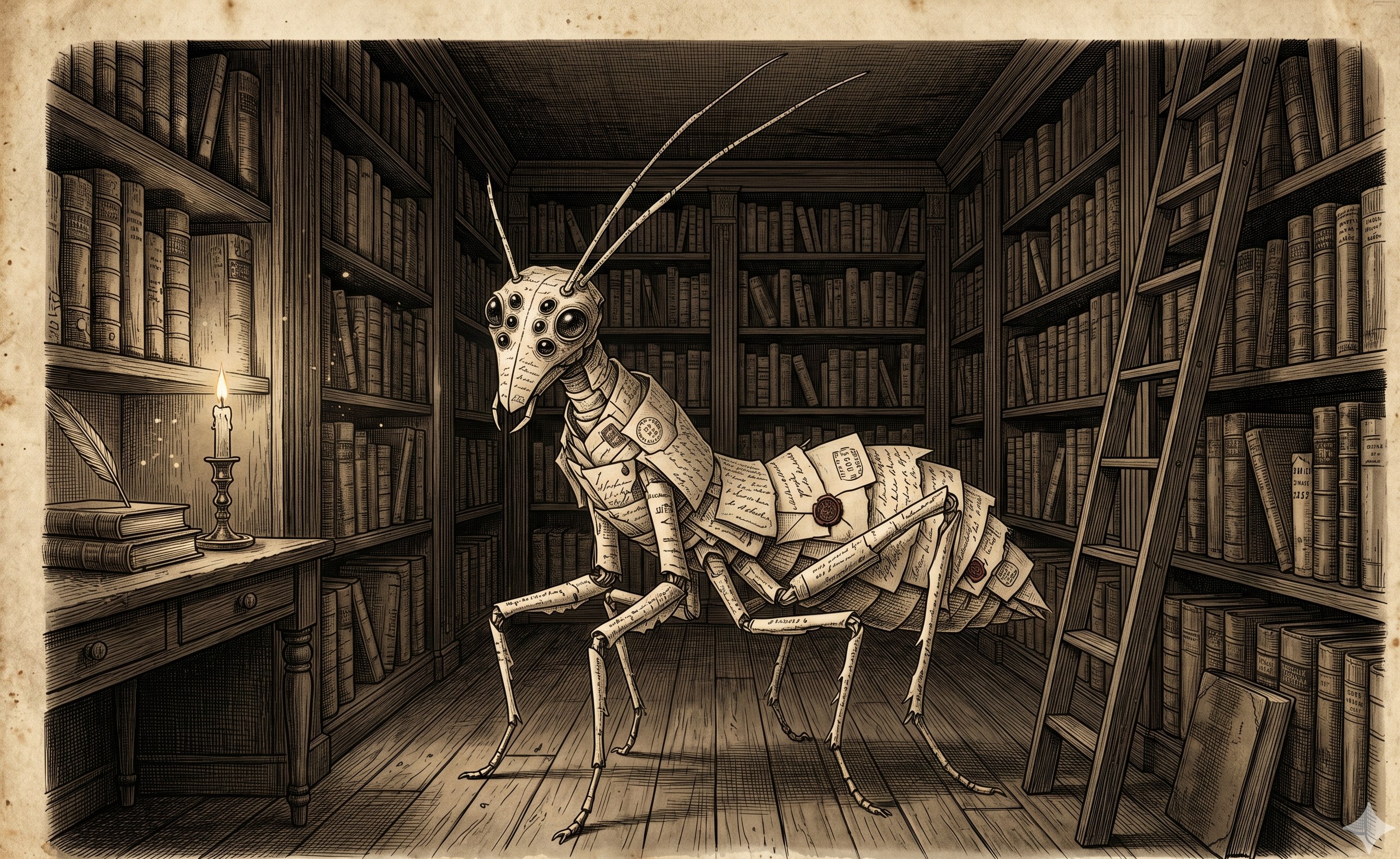
He lives in the closed stacks of old libraries and the back rooms of archival collections, and his body is assembled entirely from letters that were never delivered. If you read one of his letters aloud, it leaves him, and it stays with you. The horror of the Paper Thorax is not what happens if you read. It is what happens if you keep reading.
The Paper Thorax is the bestiary's first indoor specimen, and — by the account of every serious folklorist who has examined him — its most polite. He does not threaten. He does not pursue. He does not startle. He is, in his behavior, somewhere between a mailman and a monk. He walks the closed aisles of libraries and archives after hours, pauses before certain readers, and stands patiently for as long as is needed while you decide what to do with him.
What you are deciding is whether to read what he is carrying. He is always carrying. The letters that make up his body are real. They are letters that were written, and sealed, and addressed, and for one reason or another never reached the person they were meant for. He carries them now. He is, you could say, still trying to deliver them.
The Origin Legend
The earliest surviving account places the creature's first appearance in the back reading room of the Library Company of Philadelphia — founded in 1731 by Benjamin Franklin, still in operation today — in the autumn of 1834 or 1835. The reference comes from a cataloger's private notebook, unsigned, in the Library Company's archives. The cataloger describes being alone in the reading room one November evening after closing, working late to finish a ledger, when "a gentleman of unusual aspect" walked past him twice between the stacks.
The "gentleman" had six legs. The cataloger noted this without alarm in the notebook, which is the detail most subsequent scholars have found remarkable. There is no exclamation. There is no fear. He simply writes that the creature was "kindly in manner, and much composed of letters, and that he seemed to wish to be asked something which I could not determine how to ask."
The cataloger watched the Paper Thorax for approximately an hour before going home. He reported it to no one. The notebook entry was discovered in the 1920s during a reorganization of the Library Company's internal papers and was, for decades, considered the private joke of an overworked employee. It was Rev. Josiah Pell who, in 1931, corresponded with the archivist then in charge and requested a copy of the passage. Pell wrote back with a note that would prove to be the beginning of the Paper Thorax's entry into serious folklore:
"Your cataloger was not joking. I have received correspondence from at least four other institutions, over the past eleven years, describing substantially the same visitation by substantially the same creature. In each case he has been observed alone, after hours, and in each case he has carried something. I begin to think that what we have on our hands is a very particular animal — one that has made its living in our libraries for at least a century — and that your cataloger is owed, posthumously, an apology." — Rev. Josiah Pell to the Library Company of Philadelphia, 14 October 1931
Pell's four corresponding cases came from, in his letter's own order: a seminary library in Cambridge, Massachusetts; the basement archives of a law firm in Hartford, Connecticut; the special collections of a small women's college in Mississippi; and — this is the one scholars have lingered on — a letter Pell received from a Miss Etta Burrage, then aged twenty-three and a graduate student in folklore, who had encountered the creature in a New Orleans parish records archive in 1928.
Burrage, who would eventually become the foremost American authority on the Cistern Widow and related Delta specimens, credited the Paper Thorax encounter with setting her on her career. "He stood in front of me for twenty minutes," she wrote to Pell, "holding a letter addressed to a woman who had been dead for sixty-four years. I did not read it. I have regretted this every year since. Not because I wanted to read it — but because I am beginning to suspect that my not reading it was also the wrong answer."
What He Looks Like
The Paper Thorax stands approximately five feet at the shoulder. His body is divided, like an insect's, into three segments — head, thorax, and abdomen — each constructed from different classes of paper. The thorax is made of formal business correspondence: folded sheets of yellowed ledger paper, bills of lading, shipping manifests, demand letters, and the occasional wax seal. The abdomen is personal: family letters, love letters, news of births and deaths, letters of condolence, letters of apology, letters that should have been sent but clearly were not. The head is made of the envelopes. Every envelope on the head has been addressed and stamped and never opened.
He moves on six articulated legs, each constructed from what appears to be rolled and tightened stationery — older, thicker paper than the body — and ending in a small clawed foot made of brass or bronze. Witnesses who have looked closely agree that the feet are the oldest part of him. They appear to be 18th-century in style. Whether this suggests his age is a matter the creature's scholars have politely declined to settle.
He has multiple small dark eyes arranged on what passes for a face — typically four to eight, depending on the account. The eyes do not blink. They follow the witness calmly and without apparent judgment. His antennae are long and thin, made of wire-and-paper, and they seem to lean slightly toward whatever the witness is currently paying attention to.
He rustles when he moves. This is the detail every witness mentions. Not loudly — the sound of a careful reader turning a page — but constantly. When he stands still, the rustling continues faintly, as if the letters inside him are shifting against one another of their own accord.
The Rule of the Read
The Paper Thorax has one and only one way of interacting with human beings, and it is straightforward enough that Pell, in 1932, was able to write the rule down in a single sentence:
"He will stand before you, and hold out a letter, and wait — for as long as you need — to see if you will read it aloud. That is all he does. He does not compel. He does not punish. He simply waits." — Rev. Josiah Pell, “Notes on the Paper Thorax,” Massachusetts Antiquarian, Vol. XVII, 1932
If you read the letter aloud, in full, to its ending, the letter leaves the Paper Thorax's body. It will literally peel away from wherever it was assembled — from the thorax, from the abdomen, from the head — and fall to the floor, or land in your lap, or remain in your hand. The creature loses a piece of himself. He becomes, by the smallest measurable amount, less.
The witness keeps the letter. Its contents become part of the witness's memory. The witness knows, afterwards, what was written — and, because the letter has at last been read aloud to a human ear, the correspondence is understood (by the tradition, if not strictly by the postal service) to have been delivered.
If the witness does not read, nothing happens. The creature waits. Eventually — the duration varies; accounts report waits as short as fifteen minutes and as long as the entire night — the Paper Thorax will turn and walk away. He does not protest. He does not attempt to persuade. He simply files the matter as unresolved and goes elsewhere.
This is the first and last specimen in this bestiary that asks, rather than takes.
Why This Is Difficult
The Paper Thorax presents the witness with an ethical problem that none of this bestiary's other specimens do. Every other creature here asks only: do not engage. Do not count. Do not answer. Do not photograph. Be quiet. Be still. Be careful.
The Paper Thorax asks the opposite. He asks whether you will read.
If you read, you have done a kindness. The letter was written for a human to receive, and for nearly two centuries it has not been received, and now — at last — it has. The letter's author, who may or may not be alive, is in some quiet sense completed. The creature, who carries the undelivered as his very body, is in some quiet sense relieved. Neither of them asks anything further of you.
But you now know what was written. You know the apology that was never delivered. You know the news of the death that the sister never learned. You know what the lover wrote on the night he did not send it. You are, in Burrage's phrase from a 1952 letter, "handed a piece of someone else's unfinished grief, and asked to carry it home."
Burrage's dilemma — expressed repeatedly in her letters to Pell and to her own students — was that refusing to read also felt wrong. A letter in the Paper Thorax's body is a letter its sender once meant someone to hear. To refuse to hear is to side, in a small way, with whatever accident or cowardice or bad luck had prevented the original delivery. To refuse is also, by Pell's reasoning, to leave the creature carrying a weight he has been carrying for perhaps a century and a half.
Neither option is clean. The tradition — such as it is — does not tell you which to choose. It only tells you, unambiguously, that the choice is yours.
Reported Encounters
The unsigned cataloger who made the first record. He did not read the letter he was offered. He wrote in his notebook that it was "a letter of great apparent age, addressed to a Mr. Abednego H—, which name I did not recognize." Later research has suggested the cataloger was Joseph Ashbrook, who died in 1841 and whose own correspondence contains no further mention of the Paper Thorax. Whether he thought about the unread letter in the six years of life he had remaining is not recorded.
Etta Burrage, aged twenty-three, graduate student in folklore at Tulane University. Burrage was working alone in the archive's basement reading room at approximately 11 p.m. when the Paper Thorax walked past her reading desk, paused, and turned to face her. He held out a letter from somewhere in his abdomen. She took the letter in her hand. She read the address — a woman's name, a New Orleans street, the year 1864. She did not read further. She told Pell, in a letter later that year, that she had been unable to decide what the right thing to do was, and had settled on doing nothing. The Paper Thorax waited approximately twenty minutes. He then walked away. Burrage kept the envelope. She never opened it. She left it, upon her death in 1987, in a sealed box in her papers, labeled in her own hand: for whoever comes next to decide. The box is currently held by the Tulane University Special Collections. It has not been opened.
A reference librarian named Halbert Moss, closing up for the evening, found the Paper Thorax standing beside the card catalog. The creature held out a letter from the thorax portion of his body — a business letter, clearly, addressed to a firm in lower Manhattan. Moss, who later said he "did not particularly believe in any of this," read the letter aloud. It was a resignation letter written in 1891 by a junior clerk who, the letter explained at length and with mounting self-justification, had embezzled from the firm and intended to flee to Canada that evening. The letter had never been sent. The clerk had evidently lost his nerve and destroyed the envelope. Moss, reading aloud, realized that history had remembered this man as a long-serving and respected employee who eventually rose to junior partner. No one had ever known. The letter, upon the last word being read, peeled away from the Paper Thorax's thorax and fell to the floor. Moss kept it. He said afterward, in an interview with a folklorist in 1979, that he had not known what to do with the knowledge, and had therefore not done anything with it, and had come in the last decade of his life to consider this the correct response.
A doctoral candidate in American history named Marcus Tillery, working late in the APS reading room on a research fellowship, encountered the creature at approximately 2 a.m. The Paper Thorax offered him a letter from the abdomen — a short letter, from a young woman to her mother, dated 1919. Tillery read the letter aloud. It was four sentences. It said only that the writer was well, that the influenza epidemic had passed through her neighborhood, and that she was pregnant. She hoped her mother would come to visit before the child was born. The letter, once read, fell from the Paper Thorax to the table. Tillery has it in a drawer in his office. He has never identified the writer. He has not tried. He told a colleague, in 2023, that the letter made him call his own mother the next morning for the first time in eleven months, and that he had been calling regularly ever since. He considers this, he said, to be "more payment than the letter required of me." He intends to keep the letter unpublished for the rest of his life.
How to Respond
There is no rule for avoiding the Paper Thorax. He appears where he appears. The reader who sees him was meant, by whatever administrative logic governs the creature, to see him. What the folklore offers are three observances — in this case phrased as genuine counsels for the encounter itself, because unlike the other specimens in this bestiary, this one will not harm you, and the question is how to be worthy of him.
First: do not promise in advance. Do not decide, walking into the archive, that you will read any letter he offers. Do not decide that you will refuse. Either predetermined answer is, in Pell's phrase, "a way of not being present when he arrives." The creature's whole offering depends on the witness genuinely confronting the question at the moment he asks it. If you have already decided, you are not being asked.
Second: if you read, read in full. Read to the final word. Read the signature, if there is one. Do not skim. Do not summarize aloud. Do not stop at the paragraph you feel is the important one. The letter is what it is. It was written to be received whole or not at all. Burrage's letters to her students are clear on this point: reading partway is, in her phrase, worse than not reading at all. It leaves the sender half-delivered, which was not the kind of delivery the sender asked for.
Third: if you do read, keep the letter. Do not attempt to return it. Do not publish it. Do not share it with anyone who does not already, by accident of some later conversation, ask. The reading was the delivery. The letter now belongs to you, not because you own it, but because you are the one who is carrying it. Carry it well. Carry it the way you would carry a letter from a friend who has died: with care, with thoughtfulness, and with the understanding that the carrying is the whole of the gift.